As artificial intelligence increasingly penetrates scientific research, financial analysis, and enterprise decision-making, a critical question emerges: can we trust machine-generated data? Numbers may look clean and convincing, but mathematics is indifferent to aesthetics.
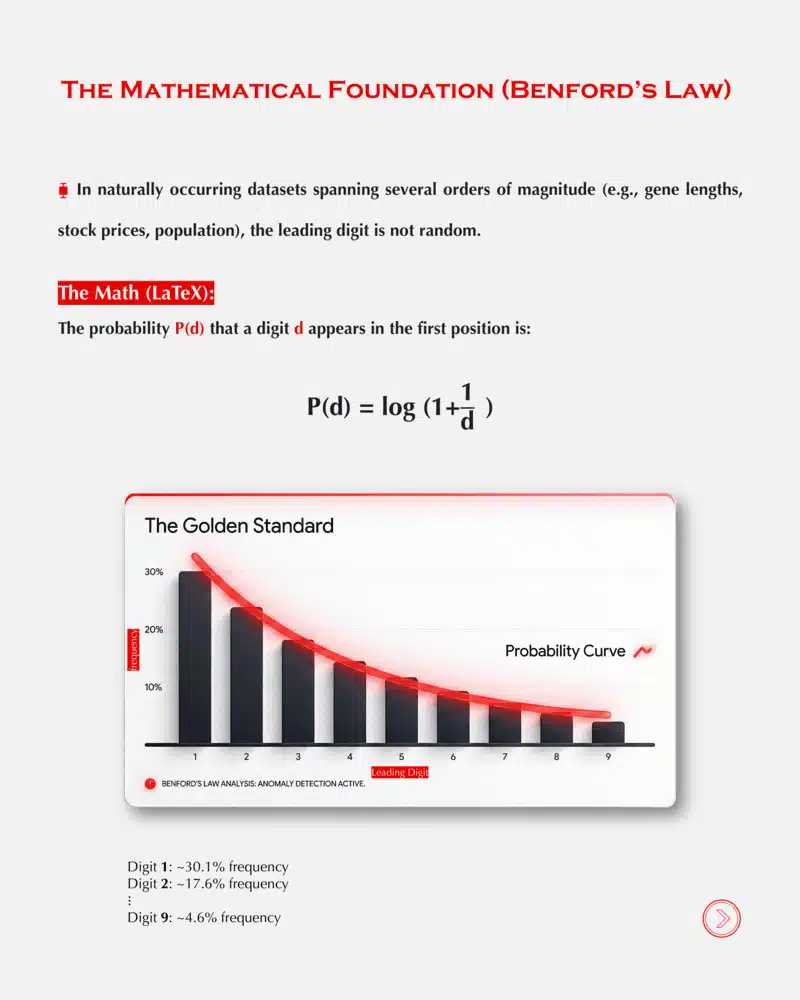
One of the most powerful tools for distinguishing natural data from fabricated data is Benford’s Law. This statistical law demonstrates that in many real-world datasets, the distribution of leading digits is not uniform. Contrary to intuition, the digit 1 appears about 30% of the time, while 9 appears less than 5%. This logarithmic decay is a mathematical signature of organic processes.
As detailed in the analytical document Math Doesn’t Trust AI, datasets generated by natural, economic, or biological processes follow this law because they arise from multiplicative, scale-invariant dynamics
. Whether measured in different units or across magnitudes, the leading-digit distribution remains stable—an intrinsic fingerprint of reality.
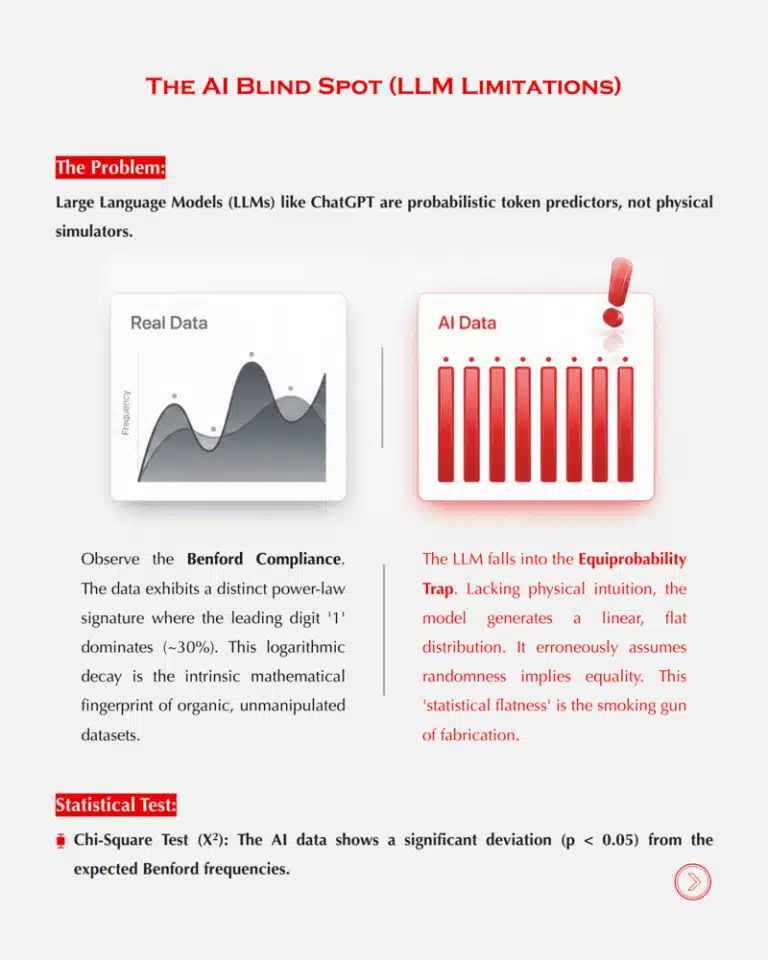
Large Language Models are not physical simulators; they are probabilistic token predictors. When prompted to generate “random” numerical data, they often fall into the equiprobability trap, producing flat, uniform distributions. From a statistical standpoint, this flatness is a red flag.
Comparative analyses show that while real datasets exhibit Benford-compliant power-law behavior, AI-generated datasets display linear, artificial patterns. A Chi-square goodness-of-fit test confirms significant deviation from expected Benford frequencies (p < 0.05), effectively flagging fabrication
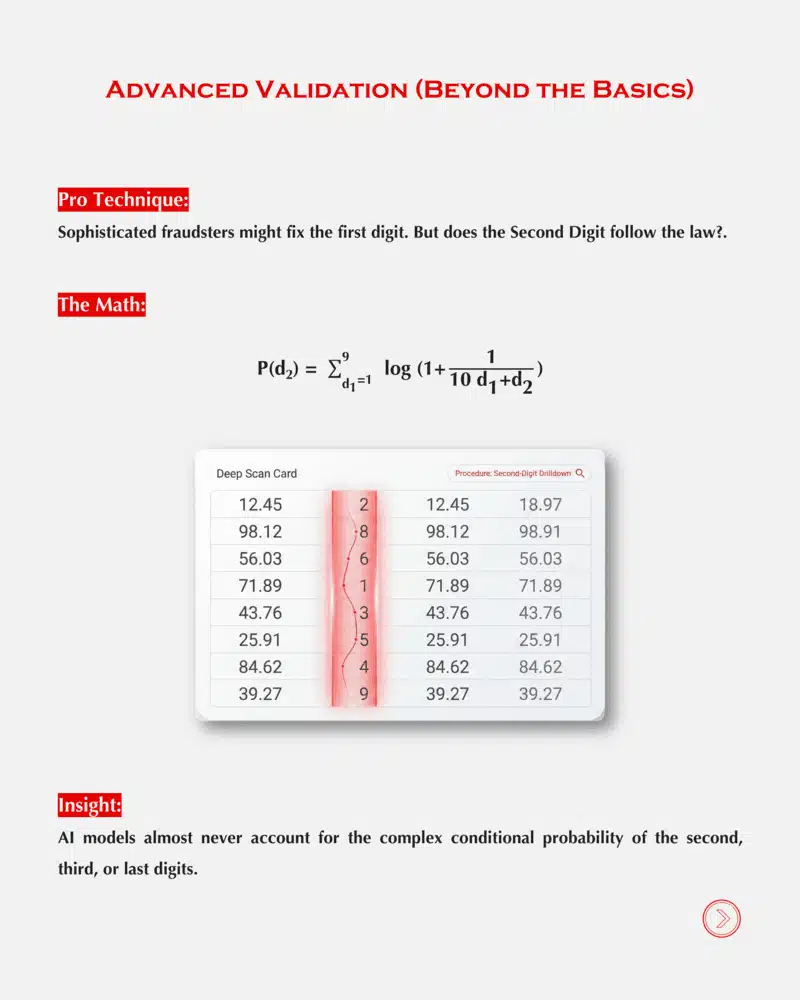
Advanced validation extends beyond the first digit. While sophisticated fraud might manipulate leading digits, second- and third-digit Benford distributions involve complex conditional probabilities—layers that AI models almost never simulate correctly. This makes Benford-based forensic analysis a robust defense against scientific fraud, financial manipulation, and numerical hallucinations.
In a data-driven world, blind trust in AI-generated numbers is risky. From peer-reviewed research to economic forecasting, statistical verification is no longer optional. Benford’s Law reminds us of a simple truth:
“AI can generate plausible numbers, but it cannot replicate the laws of nature.”
The future of trustworthy analytics lies not in rejecting AI, but in pairing it with rigorous mathematical auditing. Mathematics does not trust—it verifies.

